Thirty years after it began, Acne Studios decided to celebrate with the material it started with. In September 2026 the Stockholm house released its anniversary campaign: portraits by the American photographer Nan Goldin, showing friends of the house in denim, some of it current, some archival, some reissued for the occasion. "I have been inspired by Nan and her work for years," Jonny Johansson said in the statement released with the campaign. "I wanted an icon, but I also wanted something very intimate and personal. She does that." The subjects, he explained, are people from the house's own universe. "I wanted friends, not models."
The house began in 1996 as one discipline among several. ACNE, the Stockholm creative collective founded by Jonny Johansson with Mats Johansson, Jesper Kouthoofd and Tomas Skoging, worked across graphic design, film, production and advertising. The name started as Associated Computer Nerd Enterprises before settling into the backronym Ambition to Create Novel Expressions. Fashion arrived almost as an aside. In 1997 Johansson made 100 pairs of raw denim jeans with red stitching and gave them to friends and family. Wallpaper* and Vogue Paris picked up on the jeans, and the aside became the business: Acne expanded quickly from denim into a full fashion offer.

In 2006 the fashion company separated from the rest of the collective, parting from Acne Film, Acne Advertising and Acne Digital, and launched its own online store. What followed was a steady build into a complete house: men's and women's ready-to-wear, footwear, denim and accessories, with womenswear shown at Paris Fashion Week twice a year. Acne Studios has been a member of the Fédération de la Haute Couture et de la Mode since 2013. The stores were treated as individual projects rather than copies of a template, in cities including Paris, London, New York, Los Angeles, Antwerp and Tokyo. The Stockholm flagship occupies the Norrmalmstorg building where a 1973 bank robbery and hostage siege gave the world the term Stockholm syndrome.
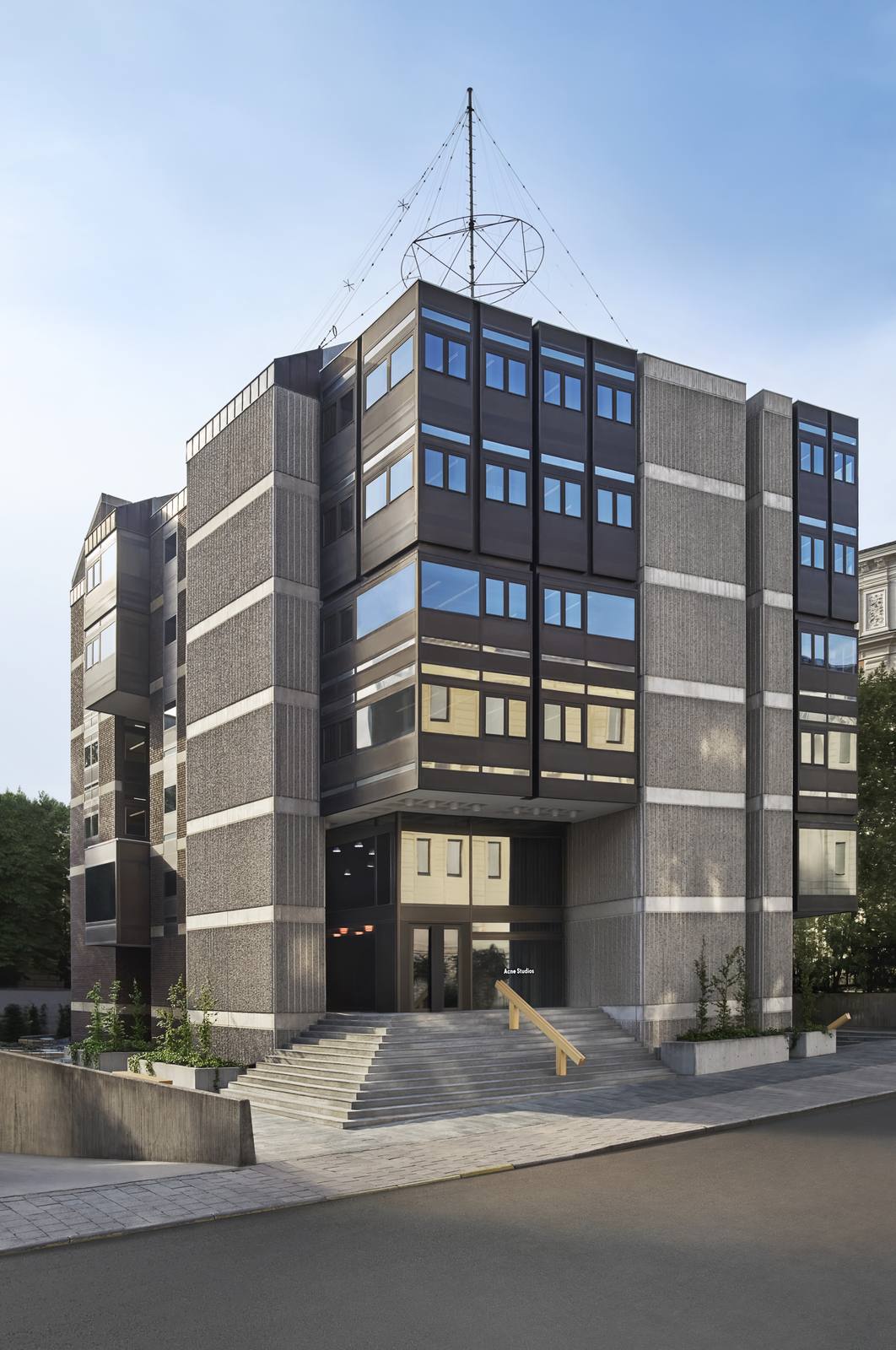
The same thinking governs the headquarters. In 2019 the company moved from Lilla Nygatan in the old town to Floragatan 13, the former Czechoslovak embassy, a listed brutalist building completed in 1972 to designs by the Czech architect Jan Bočan. Working with Johannes Norlander Arkitektur, Johansson and the in-house team rebuilt the ten floors as what they called a fashion school, with the design studio, the atelier, fitting rooms and a fabric store at its heart, and furniture and works by long-standing collaborators including Max Lamb and Daniel Silver.

Acne has never advertised in the conventional sense. Its medium is print and the photograph. Acne Paper, the biannual magazine edited by Thomas Persson, ran from 2005 to 2014 and published contributors from Carine Roitfeld and Noam Chomsky to David Lynch and Tilda Swinton. It returned in 2021, first as a commemorative book and then in new issues at an expanded format. The campaigns follow the same editorial logic, commissioned from photographers rather than agencies: David Sims for autumn 2016, and Paolo Roversi for spring 2017, whose portraits were exhibited outdoors in New York, Paris, Milan and Hong Kong.
Denim, meanwhile, was reorganised as a permanent study. On 6 April 2017 the house relaunched the whole of its denim under the name Acne Studios Bla Konst, Swedish for blue art, replacing every existing style with six permanent fits designed from scratch: the North, the River and the Land for men, the Climb, the South and the Log for women. Seasonal collections run alongside the permanent line. The launch was marked by a dedicated project store in Tokyo's Shibuya district and a campaign photographed by Collier Schorr.
The house's most recognisable mark began as an accessory. A face made of two dots and a long rectangle first appeared on a clutch in the autumn/winter 2013 collection. On 17 August 2017 it received a unisex collection of its own, spanning ready-to-wear, shoes and accessories. The house describes the face as an ordinary Swedish citizen, not too happy and not too sad: lagom, the Swedish idea of enough. It has since become the closest thing Acne has to a logo, carried on patches, knitwear and small leather goods across the range.
The business behind the work has two constants. Johansson has been creative director throughout. Mikael Schiller, the executive chairman, has run the company alongside him, and Mattias Magnusson, who joined the business in 2004, has been chief executive since 2010. In December 2018, after a year in which a full sale had been explored with Goldman Sachs at a reported valuation of up to 500 million euros, the house chose minority partners instead. IDG Capital took 30.1 percent and Hong Kong's I.T Group 10.9 percent, buying out the earlier investors Öresund, Creades and PAN Capital, while Johansson and Schiller remained the majority shareholders. "This is a dream scenario for us," Schiller said in the company's statement. I.T had been the house's retail partner in Asia for more than 15 years, and the deal was built with that market in mind. The reported scale gives the context: sales of 215 million dollars in 2016, and by the 2019/20 financial year a turnover of 2.34 billion kronor, some 800 retail partners and more than 700 employees.
The house has kept adding categories without moving its centre. Its first fragrance, Acne Studios par Frédéric Malle, composed by the perfumer Suzy Le Helley, launched on 17 April 2024, twenty-eight years after the founding. The store network, 60 boutiques in 2019/20, stood at more than 65 own stores worldwide by the anniversary year. Through all of it the structure has stayed unusual for a house of this size: independent, founder-led, and majority-owned by its creative director and its executive chairman.
Which is why the anniversary reads less like a retrospective than a restatement. The capsule reissues two jeans and a jacket: the 1996, a slim, low-rise cut, and the 2009, a bootcut, each offered in pristine raw denim and in a wash made to look lived-in for thirty years, the re-editions carrying the original red stitching and a flame patch. The Goldin cast, completed in October when the actor Emma D'Arcy became its tenth participant, is drawn from the house's own history: the musician Ellie Rowsell, the model and photographer Guinevere Van Seenus, the actor and musician Juliette Lewis, the artist Peter Schlesinger, and others who have worked with the house before. A company that began by giving jeans to its friends is marking thirty years by photographing them.
