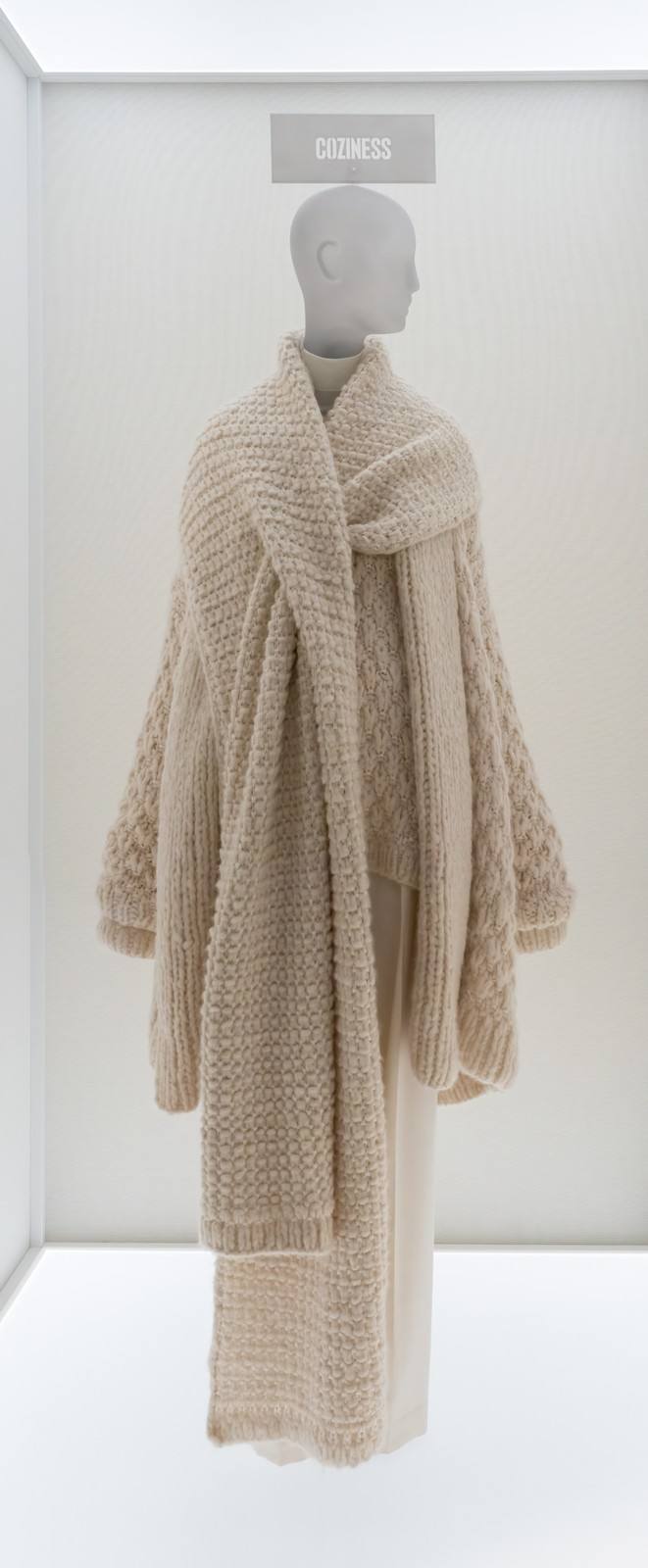
The Row is named after Savile Row, the London street where a suit is still built by hand around one body at a time. When Mary-Kate and Ashley Olsen founded the label in New York in 2006, the reference was a standard rather than a style: womenswear held to the construction discipline of bespoke tailoring, and sold without a logo of any kind.
It began in 2005 as a private exercise. Ashley Olsen set out to make a perfect T-shirt, testing the pattern on women of different shapes and ages in search of a commonality in fit and attitude. The first collection, in 2006, ran to seven pieces, among them the T-shirt, a pair of cotton sateen leggings and a cashmere wool tank dress. Barneys New York bought the whole of it.

The founders then withdrew. They did not want their own names attached to the experiment, and they gave no interview about The Row for its first three years, letting the clothes be judged without the biography of two former child actors behind them. The first look book, in 2008, was modelled by Lauren Hutton, then in her sixties, a casting decision that said more about the intended customer than any campaign could have.
The work is done in the open, if you know where to look. The studio sits in Tribeca, at 609 Greenwich Street, occupied since 2012, with offices in Paris and London. The making is distributed the way tailoring houses distribute it. When the complete menswear line arrived in 2018, after two years of research, its denim and T-shirts were made in the United States, its dress shirts in France and its jackets in Japan.

The industry's verdict arrived early and kept arriving. The Row won the Council of Fashion Designers of America's Womenswear Designer of the Year award in 2012 and again in 2015, and its Accessories Designer of the Year award in 2014, 2018 and 2019. It is the awards record of a major house, assembled while doing almost no marketing at all.
The stores follow the same rule as the clothes. The first opened in Los Angeles in 2014, inside a converted house hidden from the street. New York followed in 2016, and London in 2019, at Mayfair House on Carlos Place. In 2024 the house added a store in Amagansett and, in September, its first in Paris: a former restaurant on the Rue du Mont Thabor whose original floors and columns were kept in the renovation. Five stores in twenty years, each quieter than retail is supposed to be.
The range widened at the same unhurried pace. A first menswear capsule came in 2011, a fuller one in 2016, the complete line in 2018, and a children's collection in 2021. Accessories had grown alongside the clothes throughout: sunglasses, then handbags and shoes, with eyewear made with Oliver Peoples in 2015 and again in 2018. The discipline did not make the house immune. In 2020 the pandemic closed stores and the collapse of Barneys New York removed one of the label's largest accounts; The Row was reported to be in financial difficulty and to have cut half its staff.
Even the shows refuse distribution. The Row now presents in Paris, and since its autumn 2024 presentation there, guests have been asked to leave their phones unused and take notes by hand; the house supplied notebooks and pencils. Photographs of the clothes are released afterwards, on the house's own schedule. In a decade when a collection is content before it is clothing, The Row made attendance mean attendance.
Presentation, when it happens, is staged like an exhibition. For its autumn 2018 show in New York, the house placed the collection among sculptures from the Noguchi Museum, the museum of the sculptor Isamu Noguchi, and repeated the collaboration that September as an installation at Dover Street Market. The clothes are shown the way galleries show work: sparingly, and in serious company.
The market has priced the silence. The Cut estimated the label's sales at 100 million dollars a year in 2021. The first outside money arrived in September 2024, when the Wertheimers of Chanel, acting through Mousse Partners, and L'Oréal heiress Françoise Bettencourt Meyers, through Téthys Invest, each bought minority stakes; Natalie Massenet's Imaginary Ventures and Lauren Santo Domingo's Saint Dominique Capital also took shares. Reports of the transaction, on which the company did not comment, put the valuation at about one billion dollars. The Olsens remain the majority shareholders.
Twenty years after a seven piece collection built around one T-shirt, The Row stands as the working disproof of the modern marketing syllabus: no logo, no campaign, no livestream, and founders who decline to perform the brand in public. The refusal is not a marketing position. It is the design brief, and the clothes are what it produces.
